

What We Do
Compounding Requires Controlled Air — Not Just Controlled Ingredients
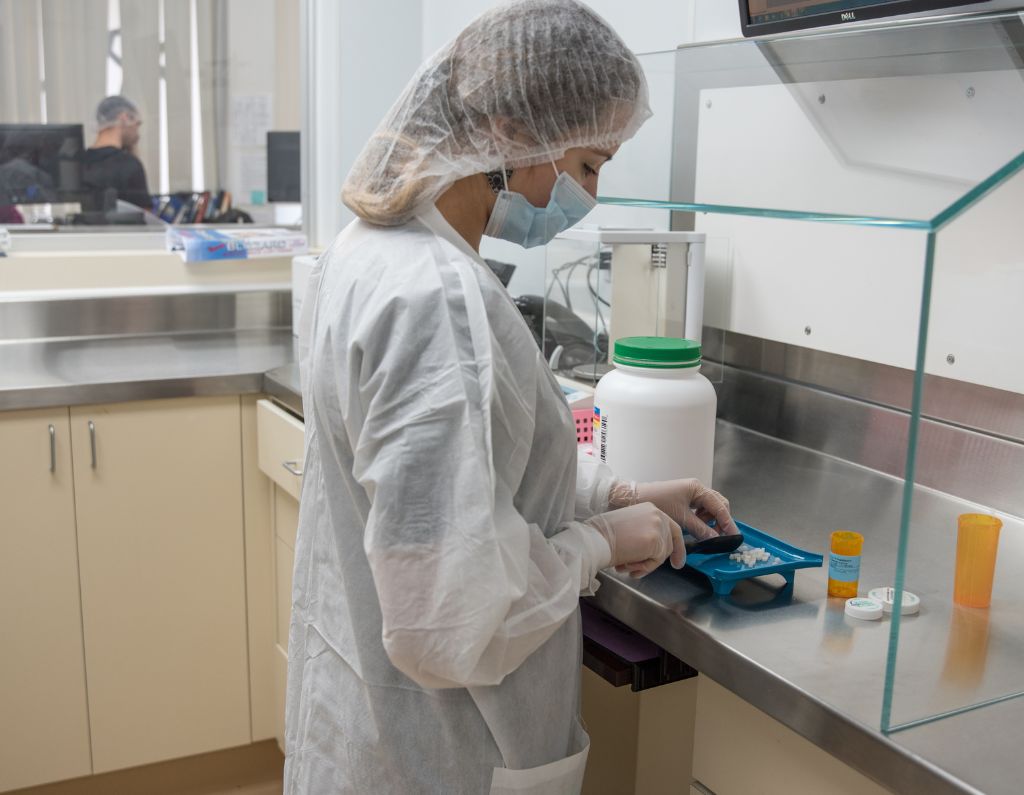
Every preparation compounded in your pharmacy leaves the facility and reaches a patient who is relying on its purity, potency, and sterility. The air in your compounding environment is not a passive backdrop to that process — it is an active variable. Airborne particulate, microbial contamination, and cross-compound carry-over in room air are direct threats to preparation integrity that begin the moment a compound is opened and prepared.
prePaer provides continuous ULPA-grade air filtration in sterile and non-sterile compounding areas, supporting the environmental quality standards that USP 795 and USP 797 require — without the cost or complexity of a full infrastructure overhaul.
The Regulatory Landscape
USP 795 and 797 Set Explicit Air Quality Expectations That State Boards Are Actively Enforcing
The 2023 revisions to USP 795 and 797 significantly tightened air quality, beyond-use dating, and environmental monitoring requirements for compounding pharmacies of all sizes. State boards of pharmacy are increasingly conducting inspections that specifically evaluate environmental controls — including the air quality in both the ISO-classified primary engineering controls (PECs) and the surrounding secondary engineering control (SEC) environment. prePaer supports the SEC air quality by continuously reducing the ambient particle and microbial load in the broader compounding area, complementing the ISO-classified equipment that handles the highest-risk preparation steps.
The Airborne Variables That Can Compromise a Compound Before It Leaves the Bench


Our Solution: The prePaer AER System
Our Solution: The prePaer AER System
prePaer operates as a supplemental engineering control in the secondary engineering control environment — continuously reducing ambient particulate and microbial load throughout the compounding day without modifying, touching, or requiring requalification of your ISO-classified primary engineering controls.
The prePaer AER System
ULPA Air Quality for the Entire Compounding Environment
ULPA Filtration at 0.12 Microns — Below ISO Class 5 Particle Thresholds:
prePaer captures 99.999% of particles at 0.12 microns — well below the 0.5 micron threshold used to classify ISO cleanroom environments. This means it removes particles in the size range that matter most for sterility assurance, including fine microbial carriers and sub-micron drug dust.
Supports SEC Environmental Quality for USP 797 Compliance:
USP 797 requires the SEC environment to maintain conditions that do not compromise the ISO classification of the PEC. Continuous ULPA filtration in the SEC reduces the ambient particle burden that the laminar flow hood or BSC must work against — supporting the environmental quality the standard requires throughout the preparation session.
Compounder Occupational Exposure Protection:
Positioning prePaer in the non-sterile compounding area during powder-handling operations captures aerosolized API dust before it disperses through the room — reducing the ambient concentration that compounders breathe across a full day of preparation work, particularly important for those working with hormones, hazardous drugs, or known respiratory sensitizers.
No Disruption to Validated Primary Engineering Controls:
prePaer operates independently of your ISO-classified hood, BSC, or CACI — it does not interface with, modify, or require requalification of those validated systems. It adds a room-level filtration layer that works alongside your existing PEC infrastructure without touching it.
Practical for Pharmacies of Any Compounding Volume:
From a small community pharmacy with a single designated compounding area to a 503B outsourcing facility with multiple preparation rooms, prePaer scales to the compounding environment. Each unit is freestanding and portable — position it where the preparation activity is highest on any given day.
Compounder Health
The People Preparing These Compounds Deserve the Same Protection as the Patients Receiving Them
Compounders who work with powdered APIs, hormone preparations, and hazardous drugs day after day accumulate occupational exposure that standard respiratory PPE only partially mitigates. Gloves, gowns, and masks address the highest-risk direct contact points — but ambient room air between primary containment operations is where chronic low-level exposure accumulates over the course of a career.
Reducing the airborne compound concentration in the preparation room is the one intervention that protects the compounder throughout the entire working session — not just during the moments when containment is actively engaged. That is the role prePaer fills in a compounding pharmacy’s occupational health framework.

Air Quality Is a Patient Safety Issue — Not Just a Compliance Checkbox
Every compounded preparation that reaches a patient has been touched by the air quality of the environment in which it was prepared. Contamination events in compounding pharmacies — whether they result in patient harm, a voluntary recall, or a state board action — are traced back to failures in environmental control. The compounding pharmacy that invests in rigorous environmental quality is not just protecting its license — it is protecting the patients who cannot obtain their medications any other way.
prePaer is the environmental quality investment that works continuously throughout every preparation session, without requiring process changes, additional staff training, or infrastructure modifications — a practical step that strengthens both patient safety and regulatory standing at the same time.