


What We Do
In a Laboratory, Contamination Does Not Announce Itself — It Invalidates Results
Laboratory and clean room environments operate on the assumption that the air surrounding work is controlled. When it is not — when ambient particulate levels exceed the tolerance of a sensitive assay, culture, or production process — the contamination event may not become apparent until results are reviewed, product is tested, or a batch is rejected. By then, the cost is already incurred.
prePaer adds a continuous ULPA filtration layer in the ambient air surrounding bench work, clean room support areas, and transitions between classified zones — reducing the background particulate load that laboratory and clean room environments must manage throughout the working day.
The Core Challenge
Personnel Are the Largest Uncontrolled Particle Source in Any Laboratory or Clean Room
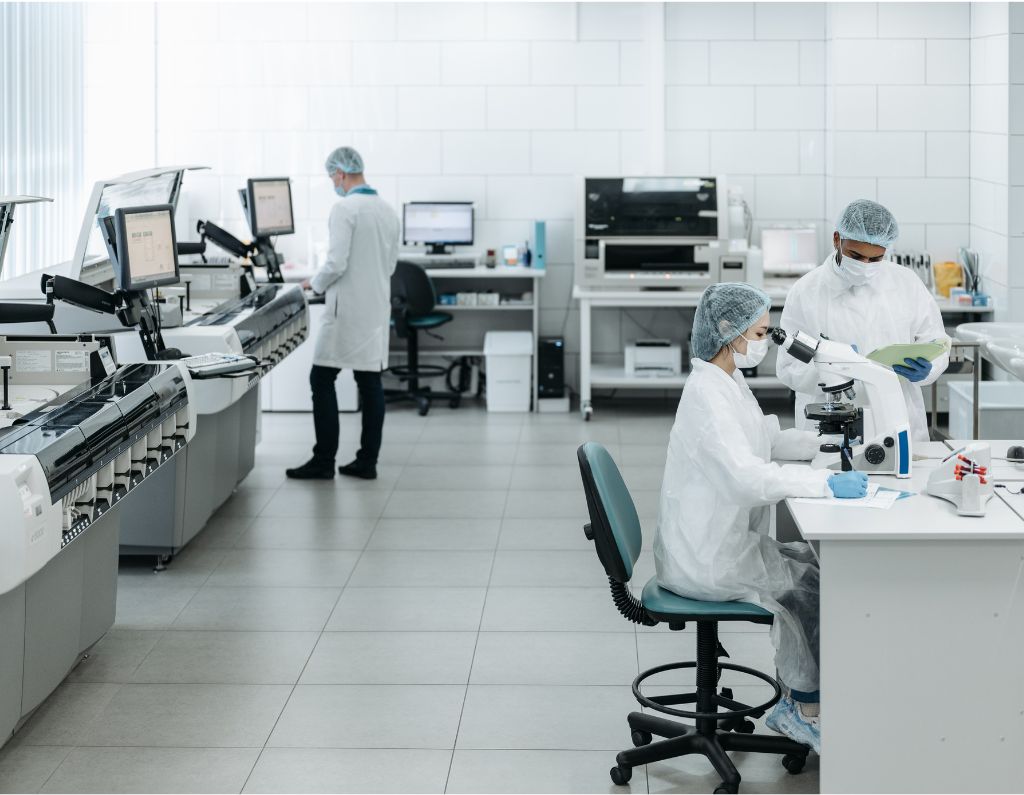
Even in rigorously controlled environments, personnel generate the majority of ambient particulate contamination — through skin shedding, respiration, clothing movement, and the disturbance of settled particles during routine activity. Gowning protocols, airlocks, and laminar flow equipment manage the highest-risk zones, but the broader laboratory environment between those primary controls accumulates particulate throughout the working session. Continuous active filtration in that environment is the supplemental control that keeps background levels manageable across the full length of a working day.
Consider This: Where Airborne Contamination Enters the Laboratory Environment
The Sources of Ambient Particulate That Validated Equipment Alone Does Not Address


Our Solution: The prePaer AER System
Our Solution: The prePaer AER System
prePaer is deployed in the spaces around and between your primary engineering controls — laboratory benches, clean room support areas, gowning corridors, and material transfer zones — where continuous background filtration reduces the ambient particle load that environmental monitoring programs measure and that classified equipment must work against throughout the day.
The prePaer AER System
Supplemental ULPA Filtration for Every Zone Where Primary Controls End
ULPA Filtration at 0.12 Microns — Below ISO 5 Particle Thresholds:
prePaer captures 99.999% of particles at 0.12 microns — below the 0.5 micron particle size used for ISO cleanroom classification. This makes it relevant for environments operating at ISO 7 and 8 classifications, where managing ambient background levels outside the primary ISO 5 zone is a routine challenge.
No Modification to Validated HVAC or Clean Room Systems:
prePaer operates as an independent supplemental unit — it does not connect to, modify, or require requalification of any validated HVAC, HVAC-R, or classified environmental system. It is assessed and introduced through standard change control procedures appropriate to your quality management system.
Portable Between Laboratory Areas and Support Zones:
prePaer can be repositioned between the active laboratory bench area, sample prep zone, material storage corridor, and gowning room depending on where particle generation activity is highest during any given work session — providing flexible supplemental filtration across the full laboratory footprint.
Personnel Bioaerosol Reduction in Open Laboratory Environments:
For laboratories working with live cultures, respiratory pathogens, or aerosolized biological agents, prePaer provides continuous ambient bioaerosol filtration in the broader laboratory space beyond the BSC — reducing the background biological contamination that personnel breathe and that can settle on open work surfaces during the session.
Supports Consistent Environmental Monitoring Results:
Consistent low ambient particle counts in laboratory support areas reduce the frequency of environmental monitoring excursions that require deviation investigation. Active background filtration is a straightforward, documentable control that contributes to monitoring program performance over time.
Research Integrity
Contamination Does Not Just Ruin a Batch — It Can Invalidate Months of Work
In research laboratories, the cost of contamination is not measured only in material terms. A contaminated cell culture, a compromised assay, or an invalidated analytical run can represent weeks or months of experimental work — along with the timeline pressure, publication delays, and resource costs that follow. The researcher who must repeat a contaminated experiment is not just dealing with a technical problem — they are dealing with a schedule and budget problem.
Reducing the ambient airborne contamination burden in the research environment is an investment in the reliability of the work being done there. prePaer provides that reduction continuously and passively, without requiring changes to experimental protocols or adding steps to the researcher’s workflow.

The Gap Between Primary Controls and the Rest of the Laboratory Is Where Contamination Lives
Laminar flow hoods, biological safety cabinets, and ISO-classified rooms address contamination risk at the highest-sensitivity points of laboratory and clean room work. But between those primary controls — in the corridors, staging areas, gowning rooms, and open bench spaces that connect them — the air is often managed only by general ventilation. That gap is where ambient particulate accumulates, where personnel-generated contamination circulates, and where the background levels that environmental monitoring programs capture are established.
prePaer closes that gap with continuous ULPA filtration — a simple, deployable control that requires no installation, no system integration, and no validation of your primary infrastructure. It is the supplemental layer that makes the overall contamination control picture more complete.